
Ben Davis met Susan Hale the way reserved people often meet—through someone louder.
Two coworkers in the data department had decided, with the confidence of people meddling from a safe distance, that Ben and Susan belonged together. Both kept neat desks, spoke softly, and seemed more comfortable around books than crowds. One coworker joked that if Ben and Susan arranged their lives into spreadsheet rows, every column would line up.
So they introduced them.
Ben arrived in a pressed gray button-down, sleeves rolled exactly once at each wrist. Tall and narrow-framed, with parted brown hair and wire-rimmed glasses, he looked like a man still weighing a thought from minutes ago. Susan wore a navy cardigan over a plain white blouse, her dark hair pinned into a low bun. A few loose strands softened her face, and her careful eyes suggested she noticed more than she said.
Their first conversation passed with no sparks, which somehow suited them. Ben paused before speaking, as if weighing each word, and Susan asked questions that moved the conversation forward naturally. Neither tried to impress the other. Neither considered it necessary.
Within a year, they married. The courthouse clerk stamped their papers without looking up. Ben and Susan exchanged a brief smile, and by afternoon, they were home again, reading in the living room as if nothing had changed except the paperwork.
Their life settled into a rhythm so exact it could have passed for design. Each morning, the alarm chimed at 6:45 while pale sunlight slipped between the blinds. They brushed their teeth at adjacent sinks, moved around each other, never bumping elbows, and left the apartment at 7:15. At work, they parked in the company lot’s third row—two spaces from the curb, always the same spot—and entered the building as the shift bell echoed down the hall.
The data department felt almost monastic. Ben typed steadily while Susan reviewed entries beside him, their screens glowing with numbers and names as handwritten forms became clean digital records. At noon, they ate beneath the buzz from fluorescent lights: sandwiches, water, sometimes yogurt. At five, they clocked out and walked to the car at an easy pace.
Evenings followed the same pattern. Dinner simmered while one read nearby. Sometimes they watched documentaries on arctic expeditions, lost civilizations, or deep-sea trenches—stories where danger unfolded on a screen while they sat safely on the couch. On Thursdays, they went to the movies because Thursday nights drew the smallest crowds. Their favorite place stood three blocks from their apartment: a small bookstore that smelled like paper and dust, where they drifted through the aisles and exchanged glances over titles the other might like.
Adventure, conflict, discovery—they read about those things, but they never lived them.
Their coworkers noticed.
One afternoon, Derek leaned back in his chair and watched them over his lunch tray. Broad-shouldered and naturally loud, he wore a loosened tie, rolled sleeves, and the easy grin of a man who believed silence invited conversation.
“You two ever do anything?” he asked.
Ben looked up from his sandwich. “We read.”
Derek laughed. “I mean anything exciting.”
Susan tilted her head, considering the word like a problem at work. “Define exciting.”
Derek pointed his fork between them. “You guys are like background characters in your own lives.”
The comment didn’t sound cruel, but it followed them back to their desks. When Derek asked if they ever traveled, went somewhere random, or explored something they actually enjoyed, Ben and Susan looked at each other across the table. The idea felt unfamiliar and oddly bright.
Finally, Susan said, “That’s… not a bad idea.”
It marked the first spontaneous thing either had said in years.
They planned a vacation with their usual care. A road map covered the dining table for several evenings as they marked towns calm enough to tolerate—places with diners, antique shops, bookstores, and wooded walking trails. They chose Riverglen, a town near a mountain range, where the online photos showed tidy streets and plain storefronts.
Perfect.
The drive took most of the afternoon. Ben followed the GPS while Susan read hotel reviews from her phone.
“Clean rooms,” she said. “Friendly service. Continental breakfast from six to nine.”
Ben nodded as the highway rolled between dark bands of evergreens. Then the GPS changed, and the blue route twisted across the screen.
“Turn left,” the voice said.
Ben frowned. “That’s not the route we selected.”
“Maybe traffic,” Susan said.
They followed it. The highway narrowed into a tree-lined road where branches met above the pavement in a loose canopy. The phone signal flickered, vanished for a second, then returned just as a sign appeared beside the road.
WELCOME TO HARMONY.
Ben slowed. Susan looked from the sign to the phone.
“That’s not Riverglen.”
The GPS chirped. “Recalculating.”
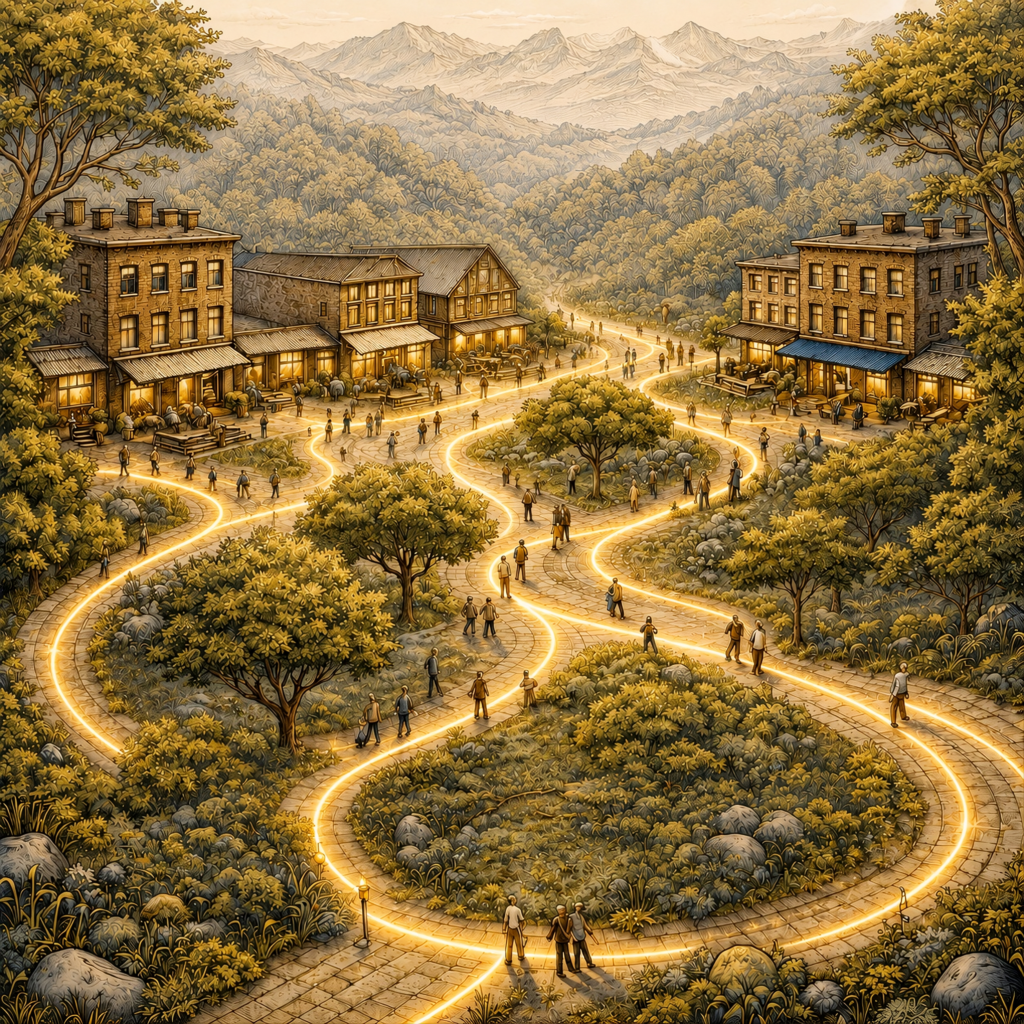
It directed them out of town. Ben followed the road past a hardware store, a barber pole, a white church with a black steeple, and a row of narrow houses with trimmed lawns. Five minutes later, the same sign appeared again.
WELCOME TO HARMONY.
Ben tightened his grip on the wheel. They tried another road, then another, but each route curved through still streets and returned them to the same intersection, the same diner, the same sign beside the faded white lines.
After the third loop, Ben parked near a diner with a flickering neon sign. “Maybe the GPS is malfunctioning.”
Susan stepped out. At first, Harmony seemed ordinary, pleasant even. A woman crossed at the corner the moment the pedestrian light changed. A cyclist passed as traffic paused. A delivery truck pulled away from the curb just as another vehicle slowed to take its place. No one rushed, and no one seemed to wait. Then Susan watched a man drop a letter into a mailbox and step away just as a mail truck rolled to the curb.
Her brow tightened. “Ben.”
He saw it too. The town moved as if every gesture followed instructions.
They checked into a roadside motel at the town’s edge. The building stretched beside the highway, each door facing the parking lot like a closed eye. Blue paint peeled from the railing, and an ice machine buzzed beside the office window, where a handwritten VACANCY sign leaned against the glass.
Inside the office, the clerk barely looked up. Thin, pale, and expressionless, he wore a gray vest buttoned too tightly over his shirt. Ben signed the register, and the moment the pen left the paper, the clerk placed two keys on the counter.
“Room fourteen.”
Susan looked at the keys. The timing felt rehearsed.
When they stepped outside, a police cruiser rolled into the parking lot. It eased forward, tires crunching over the gravel edge before stopping near the entrance. The engine idled, then the driver’s door opened.
A tall sheriff stepped out. In his late fifties and broad across the chest, he had silver hair cut close to his scalp and a square jaw shaded by gray stubble. His uniform looked newly pressed, and his boots shone dark enough to reflect the sky.
He studied them with interest rather than suspicion, as if they represented unfamiliar data.
“You folks visiting?” he asked.
Ben nodded. “Yes, sir.”
The sheriff reached inside his coat and removed two folded sheets of paper. “Then I’ll save you some trouble.”
He handed one to Ben and one to Susan. The paper looked crisp, freshly printed, its edges perfectly aligned.
“Everyone in this town follows a script,” he said. “Here’s yours.”
Ben unfolded the page.
8:13 AM — Breakfast at Corner Diner
9:04 AM — Visit Antique Market
10:47 AM — Walk through Maple Park
12:22 PM — Lunch
1:58 PM — Scenic Drive
3:41 PM — Visit Town Library
7:17 PM — Dinner
9:06 PM — Return to Motel
10:38 PM — Intimacy (Optional)
Susan blinked at the last line. “You’re joking.”
The sheriff’s expression did not change. “Never go off script. Pick from the options listed. Nothing else.”
Ben looked past him. Across the street, cars glided through the intersection in one smooth rhythm. A man opened the diner door just as another stepped out. Neither paused. Neither adjusted.
“And if we do?” Ben asked.
The sheriff gave a slight shrug. “Things fall apart.”
He turned before either of them could ask anything else, and the cruiser rolled out of the lot with no wasted movement.
Ben and Susan stood beside their car with the schedules in hand. A breeze lifted the corner of Susan’s page, then let it fall.
“Maybe it’s a tourist thing,” she said.
Ben studied the times, locations, and route. Every detail fit too neatly. “Maybe.”
But the paper felt less like a brochure and more like instructions.
The next morning, they followed it—not because they believed the sheriff, but because ignoring it felt more complicated than obeying.
At exactly 8:13, they entered the Corner Diner. The bell above the door rang once, and the smell of coffee and buttered toast warmed the air. A waitress in a pale yellow uniform looked up as if she had been waiting for that sound.
“Two?”
Ben nodded. She seated them near the window and poured coffee before they settled into the booth.
Outside, the street moved in perfect rhythm. A delivery truck rolled past as a cyclist turned the corner. Two pedestrians stepped into the crosswalk the instant the signal changed. Susan unfolded the schedule beside her plate.
“We’re on time.”
Ben checked his watch. “8:16.”
By the time they finished breakfast, the antique market across the street had opened at the exact minute listed on the schedule. Inside, the aisles stood empty except for them. Wooden shelves held old radios, chipped teacups, yellowed books, and brass lamps polished just enough to catch the light. The owner glanced up from the register, then returned to his newspaper. The shop felt less open than cleared for their arrival.
Susan touched the spine of an old atlas. “No lines.”
Ben looked toward the empty doorway. “No waiting.”
By 10:47, they walked through Maple Park. A jogger passed them, ponytail swinging in a steady beat, and a man pushing a stroller appeared at the next path exactly as the jogger vanished around the bend. No one crossed too early. No one slowed anyone down.
At the scenic overlook that afternoon, Ben watched the town below. Cars turned in measured intervals. Pedestrians moved like pieces on a board. Storefront signs flipped from OPEN to CLOSED as if controlled by the same invisible hand.
Susan rested both palms on the railing. “This is impossible.”
Ben kept watching the streets. “Engineered.”
The word changed the air between them.
By midafternoon, the schedule directed them to the town library. They walked down Main Street under a low sun that stretched their shadows across the sidewalk. At exactly 3:41, they reached the corner, and Ben stopped.
Across the street sat a small bookshop he had not noticed before. Its wooden sign hung crooked. Dust clouded the window. Inside, old books leaned in uneven stacks. It looked wrong, not dangerous, just unscheduled.
“I want to see that place,” Ben said.
Susan checked the paper. “That’s not on the script.”
“I know.”
Ben stepped off the curb, and the town reacted.
Clouds slid across the sun. A woman on the sidewalk stopped mid-step, her grocery bag slipping from her hand as oranges rolled into the street. Thunder cracked, and then metal screamed behind them.
Susan spun around. Two cars had collided in the intersection.
Rain fell seconds later, not as a drizzle but as a sudden sheet of water. Susan grabbed Ben’s arm and pulled him into the bookshop. The door slammed behind them.
Inside, the air smelled like damp paper and old wood. The shop owner stood behind the counter, a thin old man with cloudy glasses and a sweater fraying at the cuffs. He did not look surprised. He looked annoyed.
“You went off script,” he muttered.
Outside, sirens rose through the rain. Ben looked through the glass and saw the town’s rhythm falter. A cyclist stood beside his bike. A woman waited too long at the crosswalk. A delivery truck sat at the curb with its hazard lights blinking.
The town tried to correct itself, but something had slipped. Once a machine that complex lost its rhythm, every gear began to tremble.
The rain ended as abruptly as it had started. When Ben and Susan stepped outside, the sky had cleared to a pale gray, and water dripped from the awning in steady taps.
Across the street, the accident scene disappeared piece by piece. A tow truck secured one damaged car to its lift while the other sat pushed against the curb. Traffic cones appeared around the scene in a clean orange pattern. People watched in silence, free from panic or chaos, as if Harmony corrected accidents rather than mourned them.
The traffic lights resumed their cycle. Cars moved again. A cyclist passed as the pedestrian signal blinked white. The rhythm returned, not perfectly, but close.
Susan folded her arms tight against her chest. “We caused that.”
Ben studied the sidewalk. Some residents moved with their earlier precision. Others hesitated before stepping off curbs, as if waiting for permission from something they could no longer fully hear.
“The town corrected itself,” Ben said.
Susan looked at him. “You say that like it’s normal.”
Ben pointed toward the intersection, where a bus approached just as three people stepped to the curb. It stopped the moment they arrived. The doors opened, passengers boarded, and the bus pulled away.
Susan lowered her voice. “That’s not coincidence.”
“No,” Ben said.
That evening, they sat in their motel room with the schedule spread between them. The overhead light buzzed while cars passed the window at steady intervals. Susan drew lines across the motel notepad, adding columns, rows, and times along the side.
“You’re mapping it,” Ben said.
“If everyone has one of these…” Susan tapped the paper. “Then every movement in town follows a plan.”
Ben leaned closer. “Traffic. Restaurants. Parks.”
Susan sketched the diner, the antique market, the library, and Maple Park, connecting them with thin lines. “If they know where everyone should be, they can prevent crowds, delays, and accidents.”
Ben stared at the diagram. The lines crossed without colliding.
“A perfect system,” he said.
Susan looked up. “An algorithm.”
The word settled in the room.
The next morning, they began collecting more scripts. Susan found the first in a trash bin outside the diner, folded beneath a napkin. It had a different name and schedule, but the structure matched. They found another near the park and another inside a recycling bin beside the antique market. By noon, they had six.
Back in the motel room, Susan spread them across the table and layered them over her map. The paths formed a network. Each person moved through town in a sequence designed to intersect with others at controlled points: traffic, restaurant capacity, foot traffic, deliveries. Everything balanced. The algorithm did not guide individuals; it guided the town.
By afternoon, they began testing it. Ben arrived two minutes late to the diner. At first, nothing happened. Then a man at the counter bumped a coffee mug with his elbow. The mug slid, tipped, and shattered on the floor. The waitress froze, and a line formed behind Susan.
Susan wrote down the time. “Two-minute delay.”
Later, she skipped a scheduled stop at the bookstore and walked straight toward the park. Traffic slowed at the nearest intersection. A cyclist braked hard to avoid a pedestrian. Two benches filled earlier than expected.
The disruptions looked small enough to miss and large enough to spread.
Ben noticed how quickly the town adjusted. Traffic lights changed faster. People crossed to different sidewalks. A shopkeeper unlocked his door ten minutes early. The system adapted, but not instantly. Each deviation made it work harder.
Something changed in Ben too. He started talking to people. At the general store, he asked a cashier how long she had lived in Harmony. She paused with one hand on the register key.
“Long enough,” she said.
At the diner, he asked a man at the next table whether he ever left town. The man stared at him.
“You follow the schedule.”
Nothing more.
Susan filled page after page with notes. She measured how long the town took to recover and predicted which intersections would falter when they changed their routes. Her predictions often proved right.
For the first time, their old habits became useful. Ben’s patience, Susan’s focus, and their attention to detail had once made them seem invisible. Now those same traits helped them see what everyone else obeyed.
They argued theories while walking through town, laughed when a prediction worked, and stayed awake past midnight scribbling diagrams across motel paper. Outside, Harmony kept repairing itself, but Ben and Susan had begun pulling at the threads. Once someone understood the pattern, the system could never return to perfection.
Late afternoon sunlight stretched across the motel parking lot. Ben stepped outside carrying an empty paper cup while Susan remained in the room, sorting their notes. He lifted the lid of the trash bin beside the ice machine.
Beneath folded schedules and takeout wrappers, another white page caught his eye.
Another script. Ben unfolded it, and his breath stopped.
“Susan.”
She stepped outside, still holding her pen. “What is it?”
Ben handed her the page. Susan scanned the first line, then the second. Her face tightened.
6:11 PM — Drive black van to motel
6:18 PM — Abduct Ben Davis and Susan Hale
The parking lot remained ordinary. A man loaded boxes into a pickup across the street. A dog barked twice in the distance. The ice machine hummed beside them. Everything looked calm.
Below the instructions, one final line waited.
Subjects disappear. Balance restored.
Susan lowered the paper. “Ben…”
He checked the time. 5:02 PM.
“Maybe it’s fake,” she said, but she did not sound convinced.
Ben scanned the lot: parked cars, motel doors, reflections in windows. Nothing looked unusual, which made it worse. The schedule had been printed for someone, and whoever it belonged to would arrive in a little over an hour.
Susan folded the page. “If the algorithm detects a disruption…”
“It removes the variable,” Ben said.
Susan looked at him. “Us.”
Inside the motel room, the air felt tighter. The conditioner hummed beneath the window, and the curtains shifted in the weak breeze. Susan laid the abduction script beside the others. The schedules no longer looked like itineraries; they looked like orders.
Ben stared at the time. 6:11 PM.
“We should leave,” Susan said.
Ben wanted answers. A town engineered around predictive behavior suggested someone had designed it. Someone watched. Someone measured the results. But the page on the table made one thing clear: they had gone too far.
“Pack the car,” he said.
They moved quickly. Susan gathered the notes and scripts, sliding them into a folder before tucking it into her backpack. Ben folded their clothes into bags with shaking hands he tried to steady. He stepped outside first.
The road beyond the motel sat empty. Almost too empty.
He started the car and checked the dashboard clock. 5:28 PM. Plenty of time.
They pulled onto the street. At first, Harmony behaved as it always had. Cars moved through intersections with smooth precision. Pedestrians reached crosswalks as signals changed. Store doors opened and closed in perfect rhythm.
Then the roads began turning against them. The diner appeared again, followed by Maple Park, then the antique market.
Ben tightened his grip on the wheel. “We’ve already passed this.”
Susan stared at the GPS. “It’s redirecting us.”
The phone spoke calmly. “Recalculating.”
The town held them inside.
At the next intersection, the light turned yellow. A delivery truck rolled across their path. Two pedestrians stepped off the curb. A cyclist slowed beside a mailbox. For one breath, the whole street seemed to pause, as if the algorithm needed another second to contain them.
Ben turned hard. He did not turn where the GPS wanted or where the road seemed to invite him. He turned away.
The car lurched onto a narrow street neither had seen before. Trees crowded both sides, their branches clawing over the road. The GPS flickered violently, then stabilized.
The signal returned, and a highway appeared on the map.
Ben pressed the accelerator. Behind them, Harmony shrank into the trees. Its streets vanished as if the town had never been meant to exist beyond its own boundaries.
Neither spoke for several minutes. The engine hummed beneath the fading sunlight.
Hours later, they reached Riverglen, the town they had originally chosen. A wooden sign stood beside the road.
WELCOME TO RIVERGLEN.
Ben slowed as they passed it. Susan turned and looked back down the empty highway. There was no sign of Harmony, no side road, no welcome sign—only asphalt disappearing into the mountains.
They parked outside a small diner and sat with the engine off. For once, no schedule told them when to move, no voice told them where to turn, and no page waited in their hands.
Finally, Ben spoke. “So.”
Susan looked at him. “What do we do now?”
Ben considered the question, then said something neither would have imagined saying a week earlier.
“I don’t know.”
Susan leaned back in her seat. A smile touched her mouth.
Outside, someone laughed near the diner entrance. A car horn sounded too long. A child ran across the sidewalk, and his mother hurried after him.
It was messy, unplanned, and human.
For the first time, uncertainty did not feel uncomfortable.
It felt like freedom.