
Dr. Leonard Park adjusted his tie as he stepped out of the research facility, exhaling into the crisp night air. The world beyond the high-security fence was quiet—except for the erratic pacing of a man just outside the perimeter. His gait was uneven, his movements restless.
Leonard nearly dismissed him as a vagrant, but something about the figure tugged at his memory. It wasn’t until the man turned and locked eyes with him that the realization struck.
“Dr. Alistair Finch?” Leonard’s voice wavered in disbelief.
The man froze. His beard was wild, streaked with gray. His clothes hung from his frame like remnants of a forgotten life. But it was his eyes—hollow yet alert—that confirmed his identity.
“Well, well,” Finch murmured. “A man of science who remembers me.” His chuckle was dry, humorless.
“You vanished ten years ago,” Leonard said, stepping closer. “Your work on multidimensional theories was—”
“Monumental?” Finch interjected. “Yes, I suppose it was.” His lips curled in something between a smirk and a grimace. “And yet, here I am. A relic. A cautionary tale.”
Leonard studied him. Finch didn’t just look exhausted—he looked haunted. His posture was rigid, as if bracing for an unseen blow.
“What happened to you?”
Finch inhaled sharply, his gaze flicking toward the stars. “I need a man of science to witness something before I die.”
Leonard frowned. “You don’t look like you’re dying.”
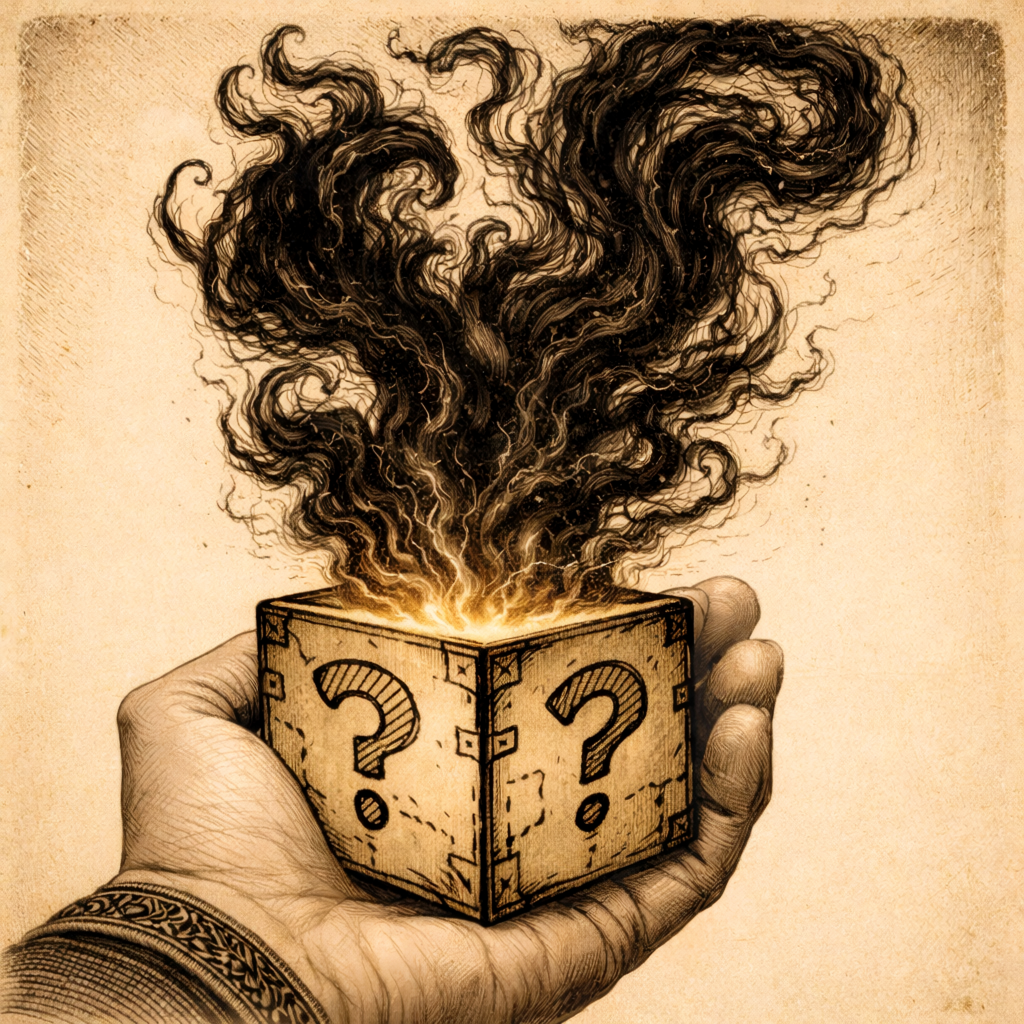
Finch huffed a breathy laugh. “That’s the thing about certain kinds of death. They don’t announce themselves. They creep.” He reached into his tattered satchel and withdrew a small wooden box. It was unmarked, smooth—almost pristine against his grime-covered fingers.
“I want to give you this,” he said, extending it. “But I must ask you—beg you—not to open it.”
Leonard hesitated. “What’s inside?”
Finch’s grip tightened around the box. “Not an object. An idea.”
Leonard raised an eyebrow. “You sound like you’ve been reading too much Lovecraft.”
Finch’s face darkened. “The difference between fiction and reality is that reality doesn’t care whether you believe in it.”
Despite himself, Leonard reached out. The moment his fingers brushed the wood, a strange sensation coiled through his arm—wrong, like a cold whisper creeping beneath his skin.
“Open it if you must,” Finch murmured. “But once the idea takes root, you’ll never see the world the same way again.”
Leonard forced a smirk. “You’re being cryptic.”
Finch’s gaze bore into him, unblinking, intense. The weight of his stare felt like a physical force, pressing against Leonard’s chest. His fingers twitched slightly, as if resisting the urge to grab the box back. “Have you ever wondered about the people who disappear without a trace? The ones we never find?” His voice was low, almost reverent, carrying the weight of something he had witnessed firsthand.
Leonard sighed. “Crime, trafficking, accidents. There are logical explanations.”
Finch shook his head. “Not all of them. Some of them slip.”
Leonard’s fingers tightened around the box. “Slip?”
“Through the cracks.” Finch’s voice lowered. “We hear about the lucky ones—the ones who step into a parallel world for a moment and return. They walk down a familiar street, find things slightly… off. But what about those who don’t come back?”
Leonard’s throat tightened.
“Dimensional fractures,” Finch said. “I opened the box, Leonard. I accepted the idea. And ever since then, I’ve been slipping.”
A gust of wind rattled the fence, sending a chill down Leonard’s spine. Finch wrapped his arms around himself as if warding off an unseen force, his breath hitching. “One moment, I was in my apartment,” he continued, his voice unsteady, his fingers digging into the fabric of his worn-out coat. “The next, I was somewhere hot.” He swallowed hard, his gaze unfocused, lost in the memory. “I smelled blood before I even opened my eyes.” He shuddered. “And when I did—I was kneeling on dry, cracked earth.” His hands flexed involuntarily, as though feeling the rough, lifeless ground beneath them. He trembled. “And they were right there.”
Leonard felt his pulse quicken.
“There were five of them—lions, their golden eyes glowing in the dim light. One of them lifted its head, nostrils flaring. I didn’t move. I didn’t breathe.” Finch’s fingers twitched. “They smelled me first. The biggest male—a scarred beast with black streaks in his mane—took a step forward. He knew I wasn’t supposed to be there.”
“I flinched. And the moment I did, his lips curled back and a growl rumbled through his throat.” Finch’s eyes got bigger. “The last thing I saw was his muscles tensing before I snapped back—before I found myself gasping on my apartment floor, the scent of lion still clinging to my skin.”
“The plane was worse,” Finch muttered, bracing himself. His fingers twitched, clenching as if trying to grip onto something invisible, breaths coming in faster, more shallow. His pulse hammered against his ribs. “I was flying to Geneva. Middle seat. Half-asleep. Then—boom—I was outside.”
Leonard’s stomach turned.
Finch’s hands twitched as he gestured, as if still feeling the icy air slicing against his skin. “The wind was insane. A deafening roar, drowning out every thought in my head. It tore at my clothes, at my body—like it wanted to rip me apart. I was spinning. Tumbling through blackness. And then—instinct. Survival. I reached for something that was metal, freezing. Turned out I’d been clanging onto the landing gear.” He exhaled sharply, his knuckles going white as if he were gripping it now. “I was thousands of feet in the air.”
Leonard shuddered and looked away as the story turned darker.
“The pressure—it felt like my skull was caving in. My ears exploded. My lungs seized up, burning, screaming for air. I tried to cry out, but the wind devoured my voice. My fingers—” He glanced down at his hands as if seeing them fail him all over again. “Frozen. Stiff. Slipping.” His breath hitched. “I knew I was about to die.”
A silence stretched between them, heavy and raw.
“And then—I let go.” Finch’s voice cracked.
Leonard tensed.
“I didn’t mean to. My body just… failed. The second I lost my grip, I thought—this is it. This is how it all ends.” His breath came unsteadily. “And then, as suddenly as it started—I was back.”
Leonard frowned. “Back?”
Finch gave a hollow nod. “In my seat. Just… sitting there. Heart slamming against my ribs, breath ragged like I’d run for my life the entire day.” He swallowed. “The woman next to me turned, staring. Her eyes were wide. She leaned in and whispered, ‘Where did you go?’”
Leonard barely found his voice. “What happened after?”
Finch blinked, as if trying to anchor himself in the present. “Few days later, another incident occurred while I was asleep.” His voice was almost a whisper. “It happened all so suddenly, I was comfortably in my bed. And then—I was drowning.”
Leonard stiffened to Finch’s horrific experience.
“I woke up choking. Water poured into my lungs, rushing up my throat. I couldn’t breathe, couldn’t think. I thrashed, kicking up my body but it was weak, sluggish—like it hadn’t caught up with where I was.” His breath shook. “I eventually found myself breaking the surface of a pool I’d never seen before.”
Leonard can almost feel the chill from the water spreading through his chest.
“There were people around. Staring. Confused.” Finch’s eyes were distant, haunted. “I didn’t belong there, Leonard.” He exhaled shakily. “I barely made it to the edge, coughing up water—and then, just like that, I was back in my bed. Dry. But my lungs still burned. My body remembered.”
Leonard inhaled sharply.
“I’ve slipped so many times.” Finch’s gaze locked onto him now, hollow and unsteady. “ I fear that one day, I won’t come back.” His voice dropped, almost pleading. “Maybe you can stop it.”
Leonard looked down at the box. It felt heavier now, as though it contained not wood and air, but something unseen, something alive.
He should throw it away.
But he knew he wouldn’t.
Because something inside him whispered.
Open it.
The wind howled again.
And for a split second—Leonard felt the world shift beneath his feet.
Leonard looked up.
Finch was gone.