
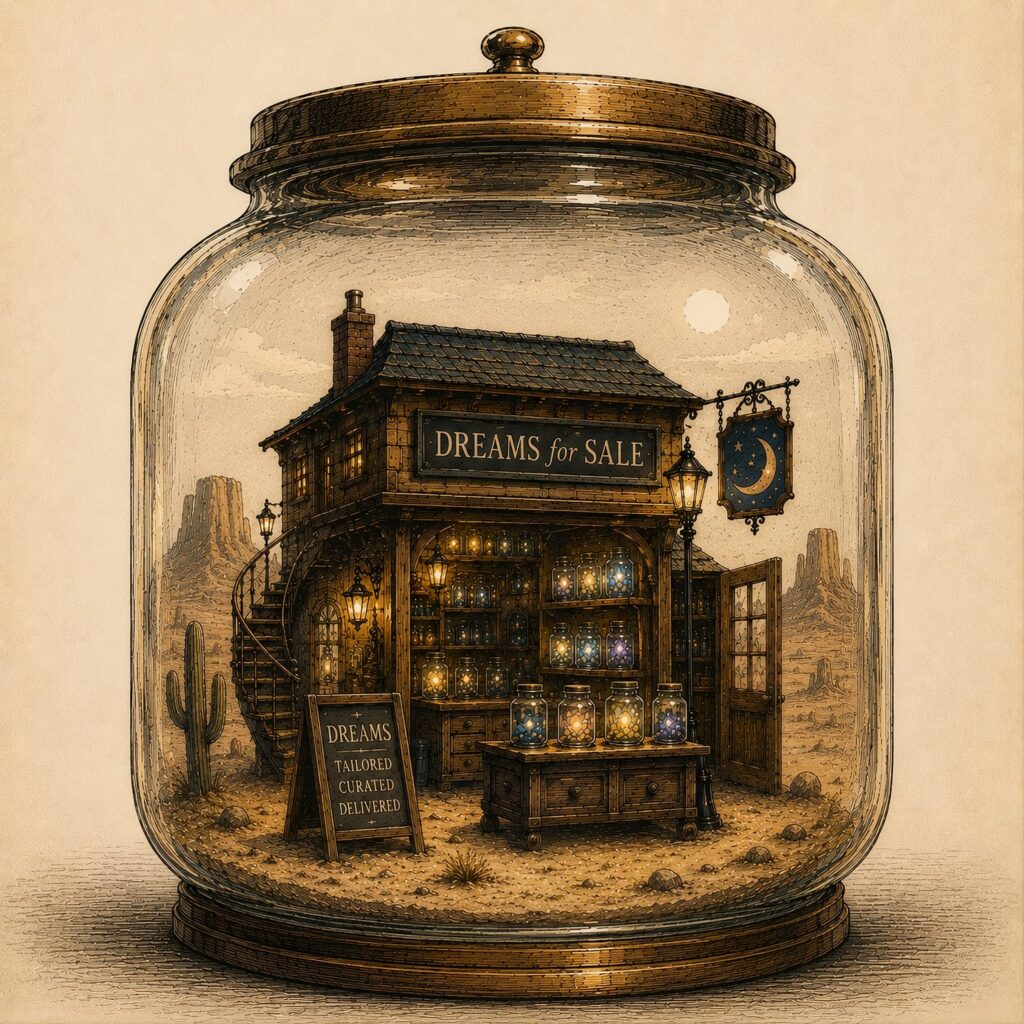
Out of nowhere, a small shop appears.
It arrives as randomly as the shifting hours of the day itself. There’s dust on the western edge of town, somewhere between Arizona and Nevada—a place nobody has any business wandering into. A place where you bring water, a compass, and extra clothes in case you end up stranded in the middle of nowhere.
Helen, an aspiring young actress on a road trip to Hollywood, adjusts herself in the driver’s seat. Golden light cuts across her lean jaw through the car window. She sits upright like a ballerina—someone accustomed to endless repetitions of stretches, flips, and cardio. The complete embodiment of discipline. But these days, most of her energy is devoted to rehearsing movie scripts line by line, chasing the perfect delivery.
She rubs her thighs together, the blue denim becoming unbearable after eighteen hours on the road. Eventually, she pulls into a barren desert town—maybe five thousand people if the estimate includes the drifters who overstay their welcome.
Dark rings stain the skin beneath her eyes.
Her body’s way of demanding rest.
Inside the local hotel, the scent of old carpet and cigarette smoke lingers in the air. As she checks in, heavy footsteps rumble across the maroon floor.
An elderly man approaches her.
Suspenders hang from his shoulders. His boots are cracked with age and layered in desert dust.
“I reckon you ain’t from around here.”
“What gave it away?” Helen laughs, setting down her luggage.
“You’re every bit a journeyman,” the old man mutters. “better be careful around these parts.”
“Careful?” she asks, his tone immediately catching her attention.
The man leans closer.
“Legend says there’s a Heckler out in the desert,” he says “a man who sells folks their dreams. Folks just like you.” He pauses. “Us locals want him gone.”
“You’re joking, right?” she says with a nervous grin.
The old man doesn’t smile.
Instead, he stares directly into her eyes without blinking once.
“Do as I say, ma’am. Get yourself some rest, then move along come morning.”
Then, just as abruptly as he appeared, he walks away.
Helen watches him disappear across the lobby, unsettled by the seriousness in his voice. Nobody could sound that convincing unless they were either telling the truth… or trying desperately to scare her away.
Still, the words cling to her thoughts.
A man who grants dreams.
Maybe not literally, she assumes. Maybe the man has connections. Hollywood contacts. Directors. Casting agents.
Exactly the kind of opportunity she’s been searching for.
It sounds ridiculous.
But so does driving across the desert with no guaranteed future waiting for her.
Helen pushes through the turnstile and steps outside, hoping to catch the old man before he disappears. Somehow, despite his age, he moves fast.
Too fast.
The parking lot sits nearly empty.
Seven sedans.
No engines running.
No movement inside any of them.
Gone.
She turns back toward the hotel and approaches the front desk, where a middle-aged clerk stands stiffly behind the counter. Fine wrinkles line his face—old enough to know the town’s history, young enough to avoid talking about it.
“Can I help you, ma’am?”
His palms flatten neatly against the desk. His red blazer is perfectly pressed down to the sleeves.
“I heard someone mention a local story,” Helen says casually. “Something about a man called the Heckler?”
The clerk’s lips flatten.
“They go northwest of here. Into the desert.”
“You know the exact location?”
He looks up at her with visible irritation. Or maybe fear.
“Sir?” she presses.
The man exhales heavily before reaching for a pen.
“If you really want to know, I’ll write it down for you.” He hesitates. “Just… be careful.”
He scribbles the address onto a slip of paper.
Undertones Antique.
Forty miles away.
Before he can even cap the pen, the turnstile spins again.
Helen is already halfway across the parking lot meeting the sun before it sets.
The GPS leads her down a narrow road branching off the main highway. Asphalt gives way to gravel, then dirt.
Eventually, she spots an abandoned ranger station sitting beside the trail—an old checkpoint once used by hikers and travelers. Its windows are blank with dust. The structure looks as though the desert has been slowly swallowing it whole.
She parks nearby.
The GPS insists the rest of the journey must be done on foot.
So she walks.
Further into the wasteland.
No trees.
No birds.
No vegetation.
Only endless miles of pale sand stretching beneath a dying sun.
Then, in the distance—
A wooden shop emerges from the heatwaves.
Helen slows.
At first, it almost looks like a mirage.
But the closer she gets, the more solid it becomes.
A faded sign hangs above the entrance.
UNDERTONES ANTIQUE
Helen reaches for the door.
The hanging bell chimes softly as she steps inside.
The inside of the shop feels strangely cold compared to the desert outside, as though the building exists beneath a different sky entirely. Helen pauses after stepping through the doorway, her fingers still resting against the handle while the hanging bell settles into silence behind her.
The place smells of cedar wood, old paper, and something faintly sweet underneath it all, a scent she can’t identify but instantly dislikes. Shelves crowd the walls from floor to ceiling, packed with antiques that appear too strange and specific to belong together. Rusted pocket watches. Cracked porcelain dolls. Animal skulls polished smooth with age. Photographs trapped inside silver frames where the faces have faded almost completely away.
Yet none of those things hold her attention for long.
Behind the counter sits row after row of glass containers filled with colored liquid. Some are no larger than medicine bottles while others resemble oversized jars used for preserving food. Crimson liquid swirls inside one. Another glows emerald beneath the lantern light. Gold. Violet. Deep blue. The substances move slowly on their own as though stirred by invisible currents.
Each container carries a handwritten label.
Love.
Power.
Recognition.
Longevity.
Fame.
Helen steps closer without realizing she’s doing it. The floorboards groan beneath her boots.
Then she notices someone behind the counter. Same suspenders. Same worn boots. Same unreadable stare fixed directly at her—the old man from the hotel lobby.
“You,” Helen says under her breath.
The old man gives a slight smile before placing a dusty rag beside an antique cash register.
“Told you to leave town.”
Helen studies him carefully, trying to understand whether she’s been manipulated or warned.
“Are you the…”
“Heckler.” He responds with a sneaky smile.
“I don’t get it…” she says, “If you’re the heckler, why try to stop me from finding you?”
The old man folds his hands together.
“For the same reason the Lord told Adam and Eve not to eat the fruit.”
Helen narrows her eyes. “And what reason is that?”
“Because the moment folks are told not to touch something,” he says softly, “it’s all they can think about.”
His answer comes calmly, almost naturally, as though he’s repeated it to many others before her.
Helen looks past him toward the shelves of glowing jars.
“You seriously expect me to believe all this?”
“That depends,” he replies. “You reckon you drove forty miles into the desert for no reason at all?”
The old man studies her silence before speaking again.
Helen doesn’t answer. Because the deeper she traveled into the wasteland, the less it felt like she was searching for the place. And more like the place been pulling her toward it.
The old man studies her silence.
“What exactly are you searching for, Miss Helen?”
Her stomach tightens. The fact he knows her name unsettles her more than she wants to admit.
“I want to be an actress,” she says. “A real one.”
“A superstar,” he corrects softly.
Helen nods.
The old man glances toward the jar labeled Fame, watching the golden liquid drift slowly inside the glass.
“Dreams are simple things,” he says. “Folks complicate them by pretending they don’t cost anything.”
“You really grant them?”
“I provide the opportunity. What folks do afterward is up to them.”
Helen crosses her arms, skeptical but unable to ignore the strange atmosphere surrounding the place.
“So what’s the catch?”
“You give me something you cherish.”
“That’s it?”
“That depends on how badly you want what you asked for.”
His eyes drift toward the necklace resting against her collarbone.
Helen instinctively touches it.
A silver chain. An angel pendant worn smooth with age. Her grandmother gave it to her before dying.
Wear this whenever you feel lost.
The memory presses against her chest.
“She gave it to me before she died,” Helen says quietly.
The old man says nothing.
Helen looks down at the necklace, suddenly aware of how tightly she’s gripping it. Part of her wants to laugh at the situation, take the absurdity for what it is, and walk straight back to her car. But another part of her keeps imagining movie premieres, flashing cameras, her name in giant letters across theater screens.
Years of rejection floods her thoughts all at once.
Every failed audition.
Every ignored callback.
Every person who warned her Hollywood destroys people before they ever matter.
Slowly, she removes the necklace and places it onto the counter.
The old man studies it several seconds before sliding it toward himself. Immediately, the jars behind him begin vibrating softly against their shelves. The colored liquids swirl fast.
The Heckler carefully removes the jar labeled FAME. Golden liquid glows inside the container, thick and luminous beneath the light.
He places it in front of Helen.
“You drink it all,” he says. “Once it’s done, there ain’t no undoing it.”
Helen wraps her fingers around the warm jar. The scent reminds her of honey and dead flowers left in the sun too long. Every rational thought tells her to leave.
But rationality never got her closer to Hollywood.
Before she can talk herself out of it, Helen raises the jar and drinks.
The liquid taste warm and sweet at first, almost comforting, before bitterness spread sharply down her throat.
Heat rushes through her body.
Every nerve hums.
The room sharpens into detail. She notices every crack in the wood, every flicker of lantern light, every ripple moving through the jars.
Then the sensation vanishes.
Helen lowers the empty jar.
“That’s it?”
The old man nods once.
“That’s all.”
She waits for something dramatic to happen, but nothing does. Only a strange feeling settles inside her, as though something invisible has shifted out of place.
When Helen steps back outside, the desert air feels cooler against her skin. And somewhere deep down, she already knows her life has changed.
***
By the time she reaches Hollywood, she has almost convinced herself the entire experience was the result of exhaustion, loneliness, and desperation colliding in the middle of nowhere.
Then she walks into the audition.
The waiting room is crowded with actresses who all look polished in the same calculated way. Sharp jawlines. Perfect posture. Expensive clothes pretending not to be expensive.
Helen sits quietly among them with her script resting in her lap while assistants move people in and out of the room.
One by one, names are called.
Eventually—
“Helen Carter?”
She rises and follows the assistant with the long ponytail through a pair of double doors.
Inside, three casting directors sit behind a wide table cluttered with coffee cups and paperwork. None of them look particularly interested in her arrival.
The tall man in the center flips through her résumé without expression while the blonde woman beside him checks something on her phone.
“You’ll be reading for Claire,” the man says absentmindedly.
Helen moves toward the taped mark on the floor.
“Whenever you’re ready.”
For a brief moment, panic creeps into her. The same panic she always feels.
Fear of sounding stiff.
Fear of forgetting lines.
Fear of being forgettable.
Then suddenly—the fear disappears.
Not gradually.
Instantly. Like something reaching inside her and pulling it out by the roots.
Helen lifts her eyes toward the room, and every word inside the script suddenly feels alive inside her mind. The emotions arrive naturally before she even speaks them.
She begins the scene.
Within seconds, the room changes.
The woman checking her phone slowly lowers it. The casting director flipping through paperwork stop turning pages altogether.
Helen sinks deeper into the performance with impossible ease, every movement landing exactly where it should. Every pause carries weight.
Her voice cracks at the perfect moment. Tears fills her eyes.
For the first time in her life, Helen isn’t trying to become the character.
She is the character.
When the scene ends, silence hangs over the room.
The casting directors stare at her.
The tall man in the center leans forward slightly.
“Can you do that again?”
Helen smiles faintly.
“Yes.”
***
Three days later, Helen sits alone in her apartment eating microwave noodles when her phone rings.
Her agent sounds breathless.
“They loved you,” he says. “Helen… you got the lead.”
Everything changes after that.
The film releases six months later and becomes an immediate success. Critics describes her performance as magnetic and unforgettable.
Suddenly, she’s walking red carpets beneath flashing cameras while reporters scream her name from behind barricades.
Premiere parties become routine.
Private invitations arrive weekly.
Famous actors introduce themselves to her at rooftop events overlooking Los Angeles.
Then another script arrives.
Another lead role.
Another hit.
Her face appears on magazine covers in checkout lines.
Directors begin requesting her personally.
Studios compete for her schedule.
Fans crowd outside restaurants hoping for pictures, while entertainment channels debate whether she’s the biggest rising actress in Hollywood.
For four years, Helen lives inside a world most people only dream about.
Until the calls begin slowing.
A role she expected suddenly disappears.
A producer stops responding.
Meetings get postponed.
Then quietly canceled.
At first, she tells herself it’s temporary. Hollywood changes constantly. Careers cool off all the time.
But deep down, panic begins settling into her stomach.
***
One night, Helen stands in front of her bathroom mirror staring at her reflection while the city glows outside her penthouse windows. The confidence that once flowed through her so effortlessly now feels hollow, drained.
And suddenly she understands.
Whatever the Heckler gave her in that desert shop…
it’s gone.
Two months later, Helen walks back into the same hotel lobby she once passed through on her way to Hollywood.
The place looks untouched by time.
The maroon carpet still stretches the floor in faded waves. Cigarette smoke still lingers in the air despite the NO SMOKING signs hanging near the entrance. One of the ceiling lights still flickers every few seconds, throwing uneven shadows against the walls.
Helen slows as she enters.
Designer sunglasses rest on top of her head, and an expensive coat drapes neatly over her frame, but none of it hides the exhaustion beneath her eyes.
Behind the desk, the clerk glances up from his newspaper.
Recognition settles across his face almost instantly.
“Well,” he says, folding the paper closed. “Looks like it wore off.”
Helen stops at the counter.
“Was it worth it?” he asks.
She hesitates.
“For a while.”
The clerk nods slowly like he’s heard the answer before.
“You’re here because it stopped working.”
Helen says nothing.
Outside, desert wind rattles softly against the lobby windows.
“I can’t go back to my old life,” she finally says.
“That’s what they all say.”
Helen lifts her eyes toward him.
“All who?”
“People chasing dreams.” He folds his hands together. “They get what they want for a little while, then come crawling back when it fades.”
Helen grips the edge of the counter tighter.
“I just need one more chance.”
The clerk lets out a dry laugh.
“No,” he says, “You need another fix.”
The words land harder than she expects.
Silence appears briefly between them before the clerk glances toward the desert outside.
“People keep feeding it,” he mutters.
Helen catches the wording immediately.
“It?”
The clerk keeps staring toward the wasteland beyond town.
“Whatever lives out there can’t be human anymore.”
***
Helen leaves the hotel before dusk settles completely. The desert road feels colder now, colder than it felt four years earlier. Wind sweeps across the empty highway, while her headlights carve narrow tunnels through the wasteland ahead.
The entire drive, the clerk’s words keep replaying in her mind.
Another fix.
Whatever lives out there can’t be human.
At first, she tries dismissing it as small-town superstition, but the deeper she drives into the desert, the harder it becomes to ignore the truth buried underneath those words…
Because he was right.
None of what happened to her felt natural.
The success came too quickly. Too perfectly. As if someone had poured confidence directly into her veins and allowed the world to bend around it.
And when it disappeared, it didn’t feel like losing fame.
It felt like withdrawal.
Helen tightens her grip on the steering wheel.
How was he doing it?
How could a dusty antique shop in the middle of nowhere manufacture dreams powerful enough to reshape people’s lives?
By the time she reaches the abandoned trail station, uneasiness begins to churn in her belly.
She takes a walk. The shop waits in the distance beneath the moonlight, exactly where it stood before. UNDERTONES ANTIQUE. Quiet. Still. Almost unreal against the endless sand surrounding it.
No lantern glows inside the front windows.
She steps carefully through the sand until she reaches the back of the building where a second entrance sits partially hidden behind broken crates and rusted barrels.
The back door hangs slightly open.
Helen hesitates before slipping inside.
The smell hits her immediately.
Rotten sweetness mixed with smoke and something damp underneath it all.
She moves slowly through a narrow hallway cluttered with shelves and old junk piled toward the ceiling. Then she hears it: a wet chewing sound—munching, slow and repetitive.
Helen freezes.
The sound continues somewhere deeper inside the building.
Then comes the bubbling of liquid.
Carefully, she inches toward the faint orange glow flickering around the corner ahead.
The back room is enormous.
Far larger than the building itself should logically allow.
A massive iron pot boils over an open fire near the center of the room while thick steam curls toward the ceiling.
Scattered across nearby tables are objects taken from dozens of lives—wedding rings, photographs, watches, children’s toys, military medals— and even handwritten letters tied together with string.
Helen’s teeth tightens as she notices some of the items partially melted inside the boiling liquid.
She flinches, sees the figure standing beside the pot. Its back turned toward her.
At first, it almost resembles the old man from town—till it starts to move.
Its spine bends unnaturally beneath the suspenders, bones shifts beneath pale skin that glistens under the firelight.
The chewing sound grows louder while long fingers stir the boiling contents slowly with a wooden ladle.
Helen takes a small step backward.
The floor creaks.
Everything stops.
Silence floods the room.
Then the creature turns around.
Helen nearly screams.
Its face is horrifyingly inhuman up close, stretched somewhere between a frog and a man. Thick clownish lips curl outward far too wide for its skull while enormous pale eyes glow faintly in the darkness.
The skin around its mouth twitches constantly, struggling to maintain the shape of a human expression.
And somehow…
it’s smiling at her.
The creature tilts its head.
“Helen,” it says softly in the old man’s voice.
She runs.
Pure adrenaline takes over as Helen bolts through the hallway, knocking shelves aside while the slow footsteps follow somewhere behind her.
The back door slams open as she stumbles into the freezing desert air.
She sprints through the sand without looking back. Only when the shop grows smaller behind her does she notices someone ahead.
A desperate woman in rags stumbles through the sand with a baby clutched tightly between her cleavage. Her hair hangs in tangled knots around her face while exhaustion drags beneath her eyes.
Yet despite how broken she looks, hope still burns inside her expression.
She’s heading straight toward the shop.
The woman whispers frantically to herself, while clutching the crying baby tighter.
“I still have something left,” she mutters.
Dread begins building inside Helen.
Before the woman can even knock, the front door creaks open.
The Heckler stands beneath the lantern light waiting for her.
Now that Helen has seen his true form, the disguise barely works anymore. The suspenders and worn boots no longer hide the thing underneath.
The woman collapses to her knees.
“Please!” she begs. “I need it back.”
The Heckler watches her patiently.
“What is it you seek?”
“My voice,” she cries. “My career. My life.”
The creature glowing eyes drift toward the baby.
“And what do you cherish?”
The woman trembles violently. Then she, slowly, begins lifting the baby toward him.
Something breaks in Helen’s heart. Because only hours earlier, she had returned to this desert wanting the exact same thing. Another chance. Another moment where the world looked at her like she mattered.
For one horrifying second, Helen sees herself becoming this woman.
Desperate enough to trade away her humane just to feel important again.
“Don’t!” Helen shouts. “Don’t give him your child.”
The woman startles. The baby squirms harder in her arms. Tears stream down the woman’s face.
“I can’t go back to being nobody,” she whispers.
Helen’s eyes dart around the shop, until they land on a stack of old receipts near the counter. Without speaking, she grabs one along with a nearby pen.
The Heckler notices her sudden movement.
Helen quickly scribbles something onto the paper while keeping it turned away from him.
Then she folds it in her hand.
The Heckler tilts his head.
“What is that?”
Helen steps closer toward the counter.
“This,” she says while gripping the folded paper, “is what I cherish.”
The creature’s glowing eyes narrow with interest.
Helen reaches the counter.
Then suddenly—
She snatches the baby from the woman’s arms and bolts toward the door.
“Sorry, mom,” Helen shouts while sprinting into the desert night. “I can’t let you do this to your child!”
The woman screams behind her.
“GIVE HER BACK!”
Helen races around the side of the building while the woman chases after her sobbing uncontrollably. The baby cries harder against her chest.
Heart thumping, Helen ducks behind the opposite side of the shop where the darkness swallows her from sight.
Then the baby continues crying as Helen muffles out the sound.
Without thinking, Helen slips back through the rear entrance.
The massive iron pot still bubbles near the center of the room while steam curls upward into the shadows above. The smell of melted objects and rotten sweetness fills the air.
Helen stares down at the folded paper in her hand.
Then quickly crumbles it up and tosses it into the boiling pot.
Purple foam erupts across the surface. The liquid hisses before fading to silence.
Helen backs away. Then runs.
On her way back to the car, the desert suddenly begins spinning around her.
The ground shifts violently beneath her feet while the stars above smear together like oil pastels.
Helen stumbles forward, disoriented.
Then suddenly —her eyes snap open behind the steering wheel of her moving car.
Tires screech across the highway surrounded by evergreens.
Helen jerks the wheel sharply, barely missing a signpost before swerving back onto the road.
Her breathing becomes frantic while headlights streak past her windows.
Slowly, realization hits her. She never became the superstar actress.
She gave up that dream as a girl long before it could ever happen.
As the desert highway stretches endlessly ahead, Helen can’t shake the feeling of the shop existing in some reality. Undertones Antique, the Heckler, the folded piece of paper, and the dream she scribbled onto it all feel too real to dismiss.
Maybe something in the desert has taken from her—
Or maybe her mind has finally bent under the weight of the journey across the country.
Helen eyes drift briefly toward the empty passenger seat as she continues toward the Grand Canyon, unsure of what she has truly escaped—or what she has only dreamed.